What Happens to Your Mutual Fund if the AMC Shuts Down?

Your fund house shutting shop sounds like a nightmare scenario. In India, it’s actually one of the most tightly regulated exits in all of finance. Here’s why your money isn’t as exposed as it feels.
Imagine waking up to news that your mutual fund’s AMC — say, a mid-sized fund house — is shutting down. Your first instinct: panic. Is my money gone?
Here’s the reassuring part: no, it isn’t. And understanding why requires unlearning one common assumption.
Your money was never “with” the AMC
Most people think of an AMC — Asset Management Company — as the entity that owns their mutual fund. It isn’t.
An AMC is just the fund manager. It picks stocks, tracks the market, and runs the scheme day-to-day. But it doesn’t hold your money or your investments
That job belongs to two other, separate entities: the Trustees and the Custodian.
Who actually holds your money
Every Indian mutual fund is legally structured as a trust. A Sponsor sets it up, but the fund’s assets belong to the trust — overseen by an independent Board of Trustees, whose entire job is to protect unit holders, not the AMC’s business interests.
The actual securities — stocks, bonds, everything the fund owns — sit with a SEBI-registered Custodian, a completely separate institution from the AMC.
So even if the AMC vanished overnight, your underlying investments would still be sitting safely with the custodian, legally owned by the trust, for your benefit. What SEBI actually requires SEBI doesn’t let an AMC just walk away. If an AMC wants to exit, or SEBI cancels its licence, one of two things must happen:
- The trustees find another SEBI-registered AMC to take over managing the schemes, or
- The schemes are wound up in an orderly way, and your money is returned to you.
Either way, trustees are legally on the hook to protect investors through the transition. And if there’s ever a change in control of an AMC — a sale, a merger, an exit — SEBI requires you to be informed in writing, with the option to exit at the prevailing NAV, without any exit load, within 15 days of that notice.
As an investor, you don’t have to do anything to trigger this protection — trustees and SEBI handle the process automatically. Your only real decision point comes if you get a change-in-control notice: that’s when you choose whether to exit or stay invested under the new AMC.
This isn’t hypothetical — it’s happened In 2015, SEBI cancelled Sahara Mutual Fund’s registration, ruling it no longer “fit and proper” to run the business. It ordered the trustees to either transfer all schemes to a new AMC within months, or compulsorily redeem every investor’s units and wind up the fund.
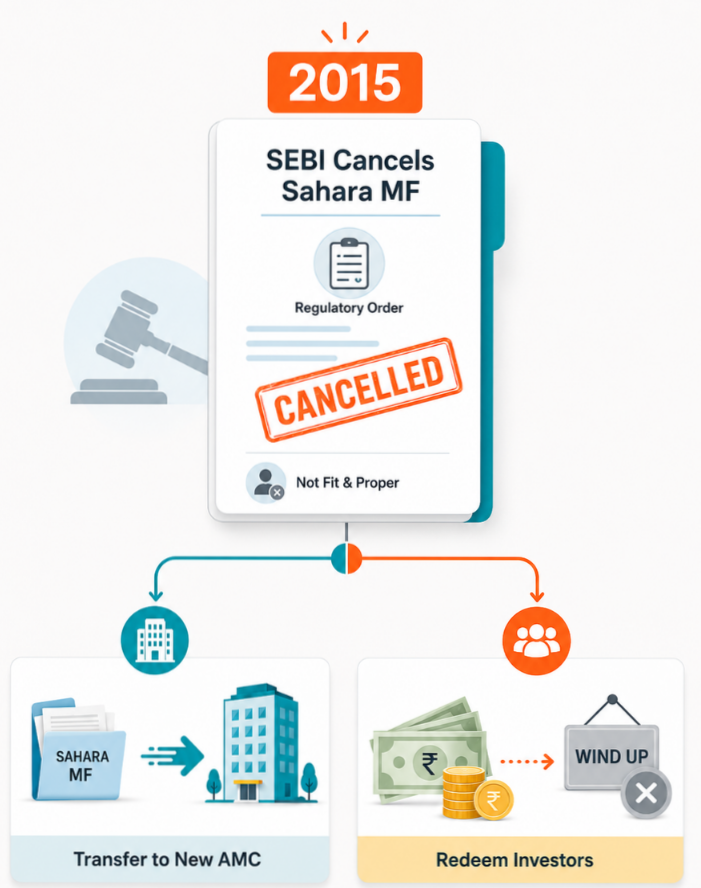
The transfer didn’t materialise in time. So over the following years, all 11 Sahara Mutual Fund schemes were wound up, and investors’ money was returned. Even now, a registrar continues to process claims for anyone who never collected their payout.
A similar mechanism played out at Franklin Templeton in 2020 — though there, only six debt schemes were wound up, not the whole AMC. Citing a Covid-era liquidity crunch, its trustees invoked the same powers, and investors eventually recovered over 100% of their money, after a long legal battle.
Nobody lost their legal right to their money — even when an entire AMC was shut out of the industry.
The bottom line
An AMC shutting down is a business failure, not a bank run. Your units represent a legal claim on real assets sitting with an independent custodian, protected by trustees whose only job is to look out for you.
Worst case, you get transferred to a new fund manager. Or your fund winds up, and you get your money back.
What you don’t get is the nightmare scenario most people imagine — your investment simply disappearing along with the company’s signboard