Sequence of Returns Risk: The Retirement Threat Most Plans Ignore
Two people retire with the same money, the same withdrawals, and the same average returns — yet one runs out of money and the other doesn’t. Here’s the retirement risk hiding in plain sight.
Meet Rakesh and Suresh.

Both retire with a corpus of ₹1 crore. Both withdraw ₹6 lakh every year to fund their retirement. Over the next 20 years, both portfolios deliver the exact same average annual return.
Yet 20 years later, Rakesh is comfortably retired with a healthy nest egg left over. Suresh has run out of money.
This is Sequence of Returns Risk — one of the most important, and most ignored, threats to a comfortable retirement.
It’s not the average. It’s the order.
Here’s the twist that catches most people off guard: once you start withdrawing money regularly, the order in which your returns show up matters just as much as the returns themselves.
Once you stop earning and start withdrawing, you’re selling investments to fund your life. If markets crash right when you retire, you’re forced to sell more units at low prices just to get the same rupee amount out. That leaves fewer units behind to benefit when markets eventually bounce back.
Rakesh and Suresh, in numbers
Say the market delivers these returns, in this order: -30%, +8%, +12%, +18%, +20%.
Suresh retires right as the crash hits. His first year of retirement is that -30%.
Rakesh retires a few years earlier. He gets the exact same five returns — just reversed. His crash comes last, not first.
Both start with ₹1 crore. Both withdraw ₹6 lakh a year. Both earn the exact same
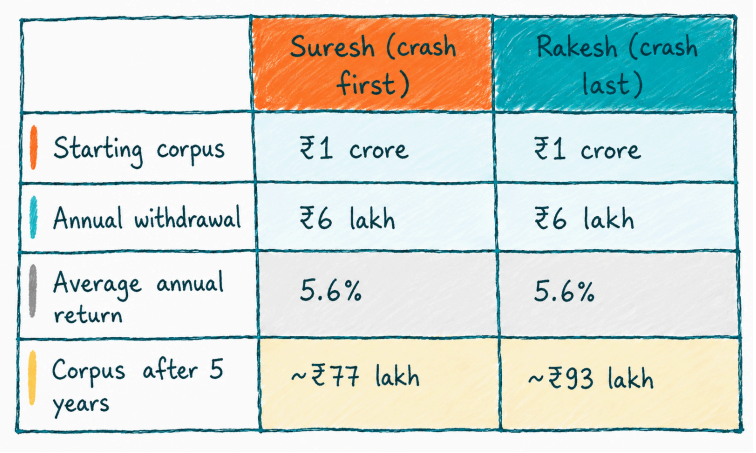
That’s a 20%+ gap — purely from the order in which the same returns showed up.
Why? Suresh withdrew money from an already-shrunken portfolio during the bad year, locking in that loss permanently. Rakesh built up a cushion during the good years first, so when his crash eventually arrived, it had a much bigger base to eat into.
Why your retirement calculator won’t warn you about this
Most retirement calculators — and honestly, most advisors — plug in a single “expected return,” like 12% CAGR for equities, and call it done.
This is why planners talk about a retirement red zone — roughly the 5 years before you retire and the 5-10 years after. A bad crash during this window can permanently dent your corpus, even if markets go on to perform brilliantly afterward.
How to actually protect yourself
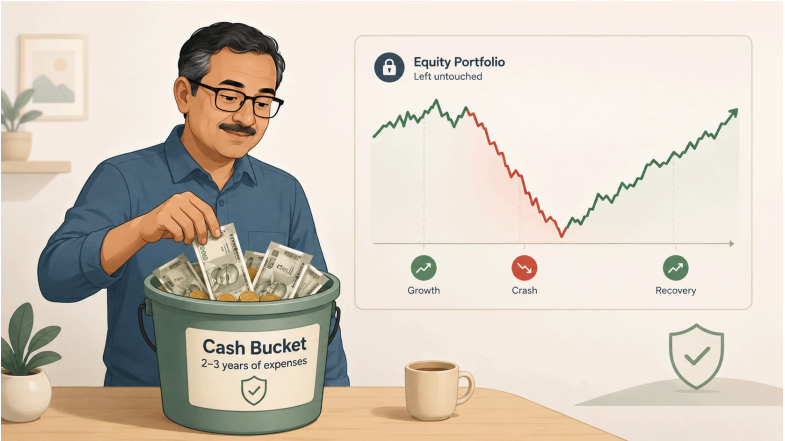
Build a cash bucket. Keep 2-3 years of expenses in liquid funds or short-term debt. When markets crash, draw from this bucket instead of selling equity at a loss — it buys time for your equity to recover.
Make withdrawals flexible, not fixed. Instead of a rigid ₹X every year, adjust based on how markets are doing. Pull out less in bad years, a bit more in good ones.
Use a “bond tent,” not a straight glide path. Conventional wisdom says reduce equity as you age. A sharper approach is to specifically de-risk right around retirement, then gradually raise equity exposure again once you’re safely past the danger zone.
Cover essentials with guaranteed income. Annuities — or the annuity portion within NPS — can lock in income for non-negotiable expenses like food, rent, and medicines, so a crash threatens your lifestyle upgrades, not your survival. Stay flexible around your retirement date. If markets crash right as you’re about to retire, even a couple of extra working years, or some part-time work, can meaningfully cut how much you need to pull from a depressed portfolio.
The bottom line
Retirement planning obsesses over one number: how big should my corpus be?
But that number alone is incomplete. The real question is: can my corpus survive bad luck showing up early?
That’s not bad planning. That’s sequence of returns risk, quietly working in the background.
The goal isn’t to panic about it. It’s to build a plan that asks not just “what return can I expect,” but also “what happens if the bad years come first?”
Because in retirement, luck matters. Planning for bad luck matters even more