Free Isn’t Free: The Real Cost of DIY Investing
You opened your demat account during the pandemic. Watched a few YouTube videos. Read some Reddit threads. Bought a handful of stocks that “felt right.” Maybe even made money for a while.
Then something shifted. The market got complicated. Life got busy. And somewhere between tracking quarterly results and rebalancing your portfolio, you quietly stopped paying attention.
This is not a rare story. It’s the default one.
DIY investing sounds liberating — no advisor fees, full control, complete ownership of every decision. What it doesn’t advertise is the hidden cost. Not the brokerage fees. The other ones.

The Overconfidence Tax
Behavioral finance has a name for what happens to most retail investors: overconfidence bias. We overestimate our ability to pick stocks, time the market, and read macroeconomic signals that professional analysts spend careers trying to decode.
The numbers are brutal. A DALBAR study tracking investor behavior over 30 years found that the average equity investor consistently underperformed the S&P 500 by 4-5% annually — not because the market failed them, but because they made avoidable decisions. Bought high. Sold low. Sat in cash waiting for the “right moment” that never came.
In India, AMFI data shows that a significant portion of direct equity investors exit within two years. Not because markets crashed, but because managing a portfolio is harder than it looks from the outside.
The Time Cost Nobody Calculates
Here’s a question nobody asks: What is your time actually worth?
If you earn ₹15 lakh a year, your effective hourly rate is roughly ₹720. Spending 10 hours a month researching stocks, reading annual reports, and monitoring your portfolio costs you ₹7,200 in time every month. That’s ₹86,400 a year — before a single wrong decision.
Most DIY investors never run this calculation. They see the 1% advisor fee and balk. They don’t see the 6 hours a week they’re spending on something a professional does full-time.
Time spent managing a portfolio is time not spent on your career, your health, or anything that compounds in ways money canno
The Emotional Cost of Watching Every Tick
Markets move every second. For a DIY investor, that’s 375 minutes of potential anxiety every trading day.
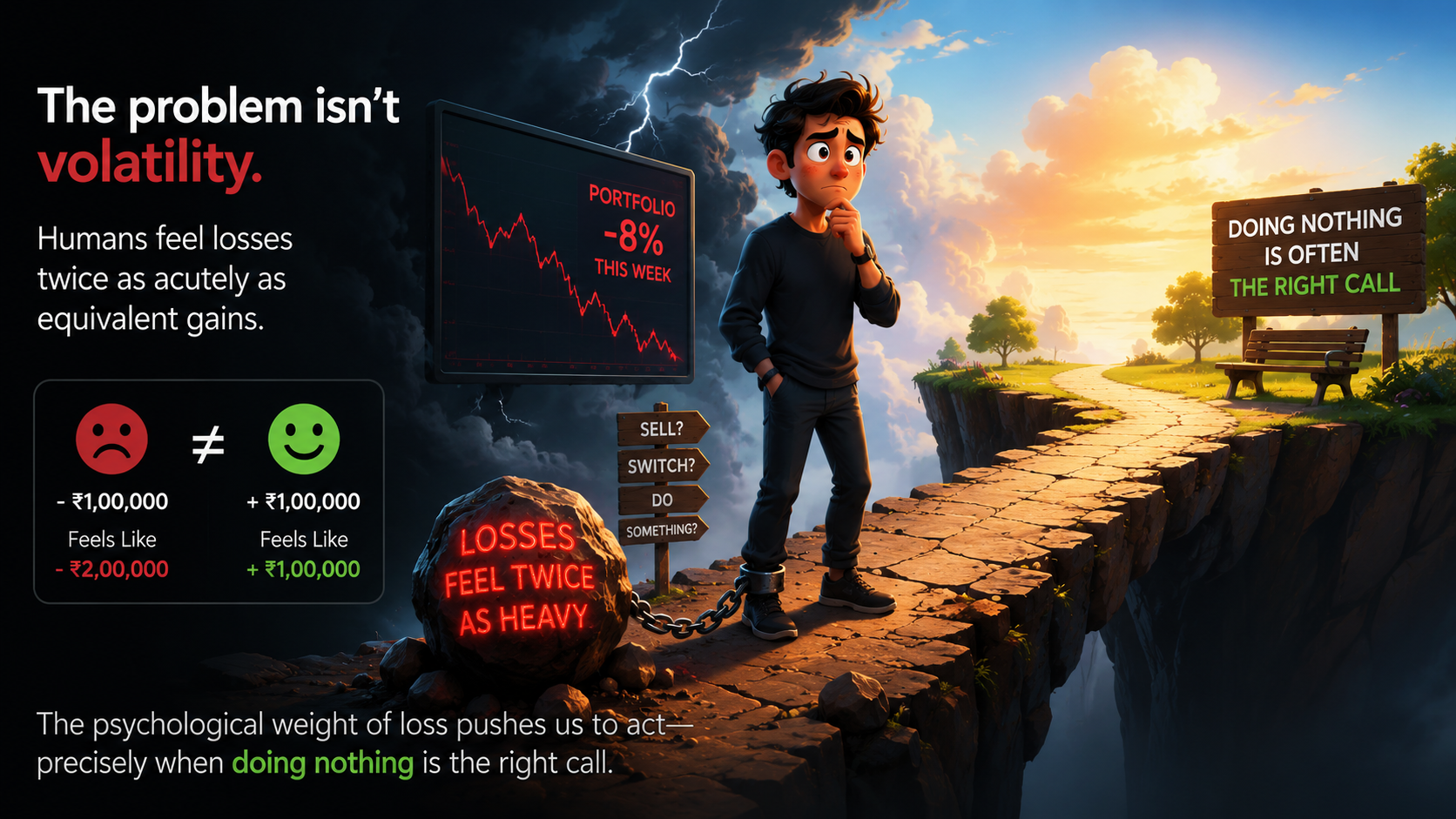
The problem isn’t volatility. It’s that humans are wired to feel losses twice as acutely as equivalent gains — a principle called loss aversion, documented by Kahneman and Tversky. So when your portfolio drops 8% in a week, the psychological weight of that loss is disproportionate to the actual financial impact. And that weight pushes people to act — to sell, to switch, to do something — precisely when doing nothing is the right call
Professional fund managers aren’t immune to emotion. But they have processes, committees, and mandates that create distance between feeling and action. The retail investor has none of that. Just a screen, a number, and a gut feeling.
The Knowledge Gap That Widens Over Time
Markets evolve. Tax laws change. New instruments emerge. What worked in 2019 doesn’t necessarily work in 2026.
A DIY investor who built a strategy three years ago and hasn’t revisited it is operating on outdated assumptions. Meanwhile, the regulatory environment around mutual funds, capital gains tax, debt fund indexation, and international investing has shifted significantly in India over the last five years alone.
Staying current isn’t optional. It’s the entire job. And for most salaried professionals juggling careers, families, and everything else, it simply doesn’t happen consistently.
The Case for Knowing Your Limits
None of this means DIY investing never works. For disciplined, informed investors who genuinely enjoy the process, it can. But enjoyment and competence are different things. And competence in investing requires time, emotional detachment, and continuous learning that most people underestimate.
The hidden cost of DIY investing isn’t the bad trade you made last year. It’s the cumulative drag of mediocre decisions, emotional reactions, and time spent on something you were never fully equipped to do alone.
A good advisor doesn’t just pick funds. They stop you from making the expensive mistakes you don’t know you’re about to make. That’s the service. And for most investors, that service is worth considerably more than the fee attached to it.
Knowing when to delegate is not a weakness. In investing, it might be the smartest decision you ever make