The Asset Class That Wins by Being Ignored

The Middle Child Nobody Talks About Indian investors obsess over large caps and small caps. The real opportunity has been hiding in plain sight.
The Asset Class That Wins by Being Ignored
Every investor in India has a strong opinion on exactly two things: the comfort of blue chips and the excitement of small caps. At dinner tables, in WhatsApp groups, in family conversations — the debate is always the same. Either “stick to the big names, sleep well at night” or “small caps are where real wealth gets built.”
What you almost never hear? Midcaps.
And that silence, ironically, might be exactly why they’ve quietly outperformed both camps for the better part of twenty years.
A Market of Three Personalities
Think of India’s listed companies as three distinct personalities in the same office.
The senior executive — decades of experience, a corner office, a name everyone recognises. Dependable. Not going anywhere fast. That’s your large cap.
The fresh hire out of college — ideas everywhere, energy to burn, zero track record. Could be your next star. Could disappear in six months. That’s your small cap.
And then there’s the mid-level manager nobody writes case studies about. Eight years in. Knows the system. Still hungry. Has something to prove. Shows up every day and just delivers.
That’s the midcap. Unglamorous. Underestimated. And quietly outrunning everyone else.

Why They’re Built Differently / They’ve Already Survived the Hard Part. What Remains Is Scal
SEBI draws the lines clearly. The top 100 companies by market capitalisation are large caps. Ranks 101 to 250 are mid caps. Everything after that falls into small cap territory.
But what makes midcaps genuinely different isn’t the ranking — it’s where they are in their journey.
They’ve already crossed the hardest part. The messy startup years, the product-market fit struggles, the near-death moments — those are behind them. What’s ahead is scale. And scaling a business that already works is a fundamentally different, far more reliable kind of growth than betting on one that might.
Companies like Dixon Technologies, Persistent Systems, and Tube Investments didn’t arrive at their current positions by accident. They earned it. And they’re not done yet.

The Volatility Trap Small Cap Investors Walk Into
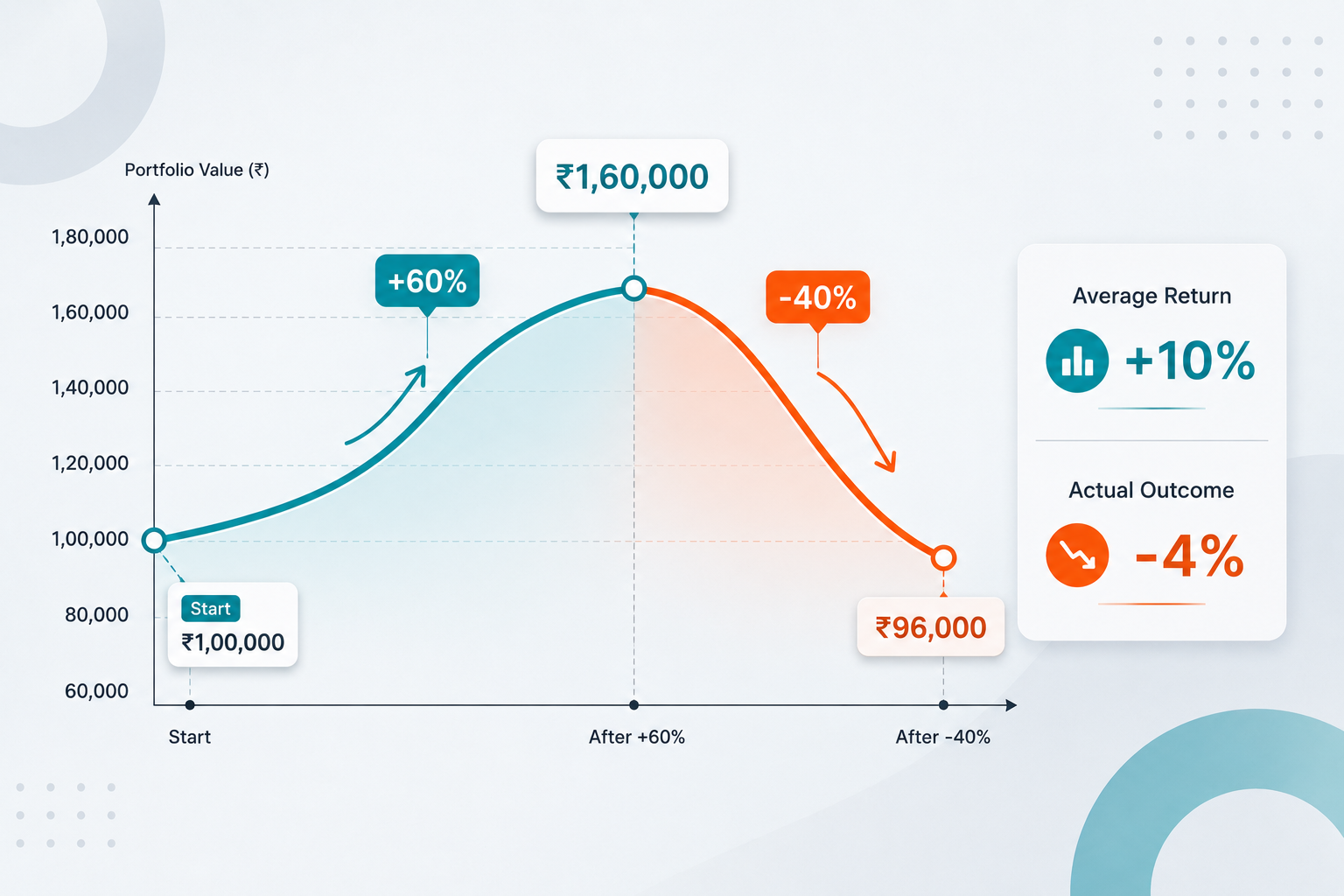
Here’s a question: if a fund delivers 60% in one year and loses 40% the next, what’s your actual return?
Most people say 10%. The real answer is −4%. Here’s how it works. Start with ₹1,00,000. A 60% gain takes it to ₹1,60,000. Then a 40% loss — not on your original capital, but on ₹1,60,000 — brings you to ₹96,000. You’ve lost money, even though the average of +60 and −40 sounds like a positive outcome.
This is the trap small cap investors fall into repeatedly. The rallies look spectacular during a bull run. But when corrections hit — and in small caps, they don’t just sting, they shatter — the recovery math is brutal. A 70% fall requires a 233% gain just to break even.
Midcaps have rough years too. But the depth of the damage is meaningfully lower. And in compounding, not falling as far isn’t a marginal advantage. It’s often the whole game.
Three Quiet Reasons the Edge Holds
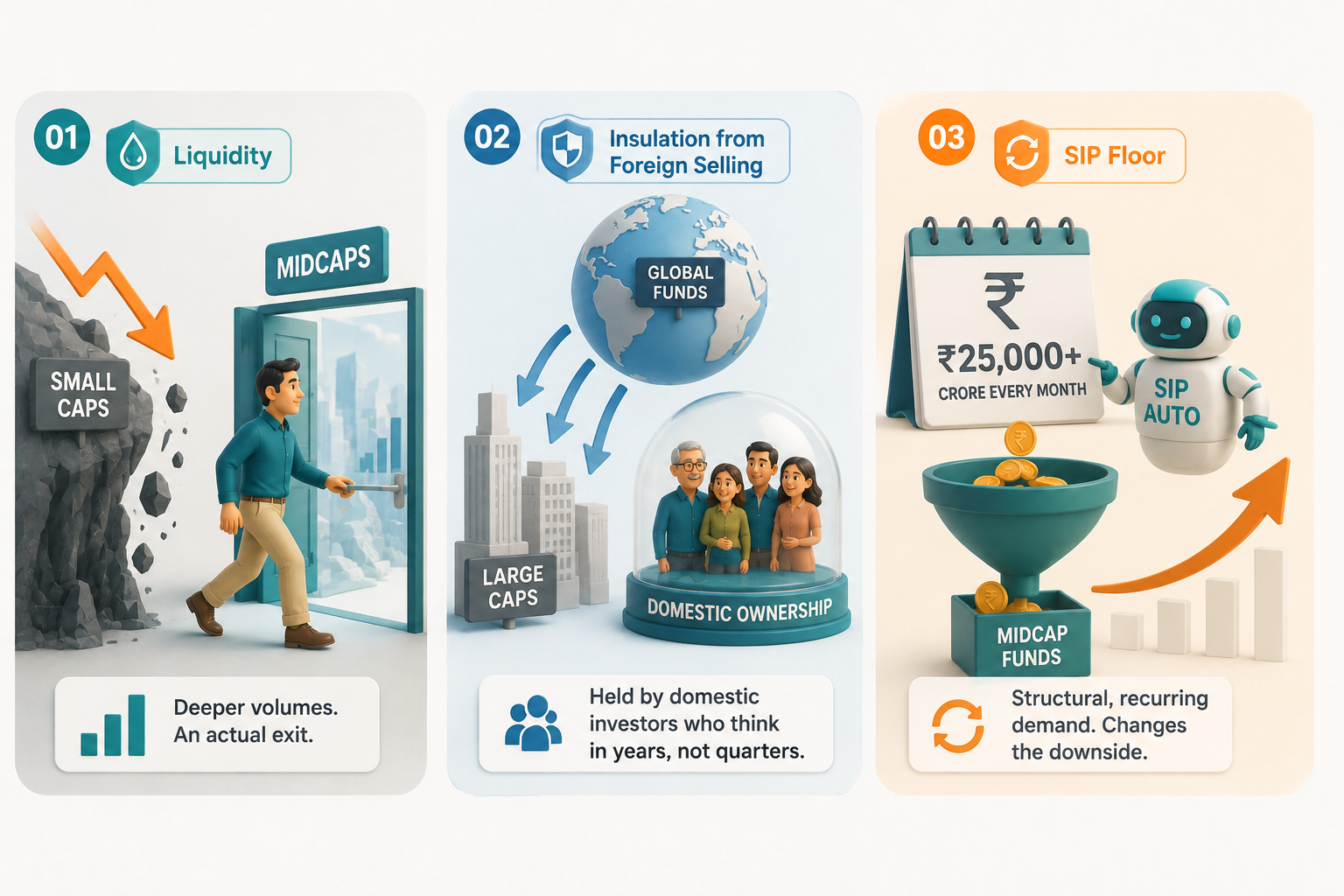
First, liquidity. When markets panic, small cap stocks can fall off a cliff simply because there aren’t enough buyers. Midcaps, with deeper trading volumes, give investors an actual exit — or at least a manageable one.
Second, insulation from foreign selling. When global funds reduce India exposure, they exit large caps first — the most liquid, most globally recognised stocks. Midcaps are largely held by domestic investors who think in years, not quarters. That ownership base is more stable than most people realise.
Third, the SIP floor. Over ₹25,000 crore flows into Indian mutual funds every single month through systematic investment plans — automatically, regardless of market mood. A meaningful chunk of that lands in midcap-oriented funds on autopilot. This structural, recurring demand simply didn’t exist ten years ago. It changes the nature of the downside.
The Returns Come With a Patience Tax
None of this makes midcaps easy to hold.
They fell sharply in 2008. They drifted through a painful 2018. They shed close to 20% during the 2024–25 correction. There will be stretches — sometimes long ones — where a midcap portfolio looks like a mistake.
The investors who actually capture these returns aren’t the ones who picked the best stocks. They’re the ones who didn’t sell during the worst months. A seven-year minimum horizon isn’t a suggestion — it’s the price of admission if you want the data to work in your favour.

So Why Doesn’t Everyone Just Do This?
Because it’s boring.
There’s no story to tell at a party about a midcap fund that returned 14% CAGR over twelve years. There’s no adrenaline. No viral moment. No stock tip to forward on a group chat.
But compounding doesn’t care about stories. It cares about time, consistency, and not blowing up your capital when things get hard.
The midcap opportunity has never been a secret. It’s just overlooked by people chasing something louder. And in investing, the crowd’s blind spots tend to be exactly where the returns live.