Why Retail Investors Always Enter Late and Exit Early
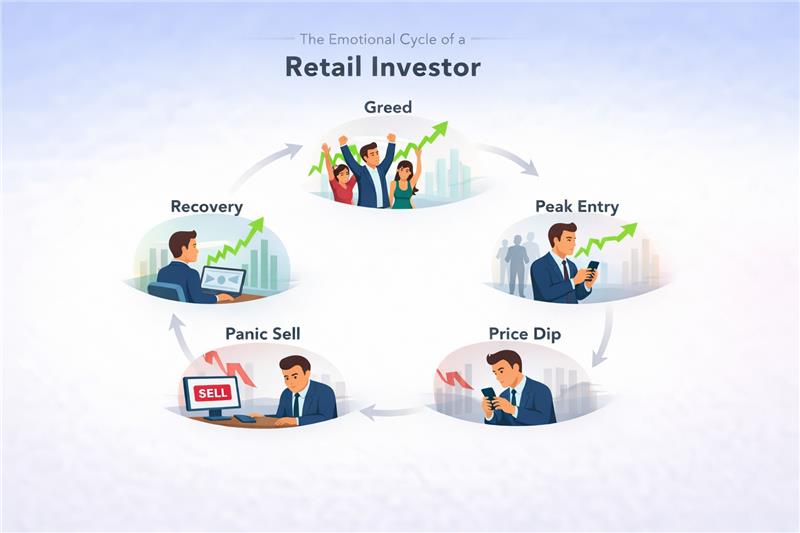
It’s not stupidity. It’s just how our brains are wired — and the market knows it.
Let me paint you a picture. It’s 2021. Your friend, your cousin, maybe your barber — someone is telling you about how they made a 40% return in three months. The news is full of it. Social media is buzzing. You feel like you’re the only one not at the party.
So you put some money in. And almost immediately, things start going down.
Sound familiar? If it does, you’re not alone. This is the oldest story in investing — and it plays out again and again, not because retail investors are foolish, but because they’re human.
“The market is a device for transferring money from the impatient to the patient.” — Warren Buffett
The problem starts with how we get our information. By the time a stock or sector is making headlines, the smart money has already been there for months. Institutional investors — hedge funds, mutual funds, big banks — they buy early, when things are quiet and boring and nobody is talking about it. Then the price rises. Media picks it up. Retail investors notice. They pile in. And that’s often when the institutions are quietly selling.
There’s a name for this cycle. It’s called the buy-high, sell-low trap — and it’s a deeply emotional loop.
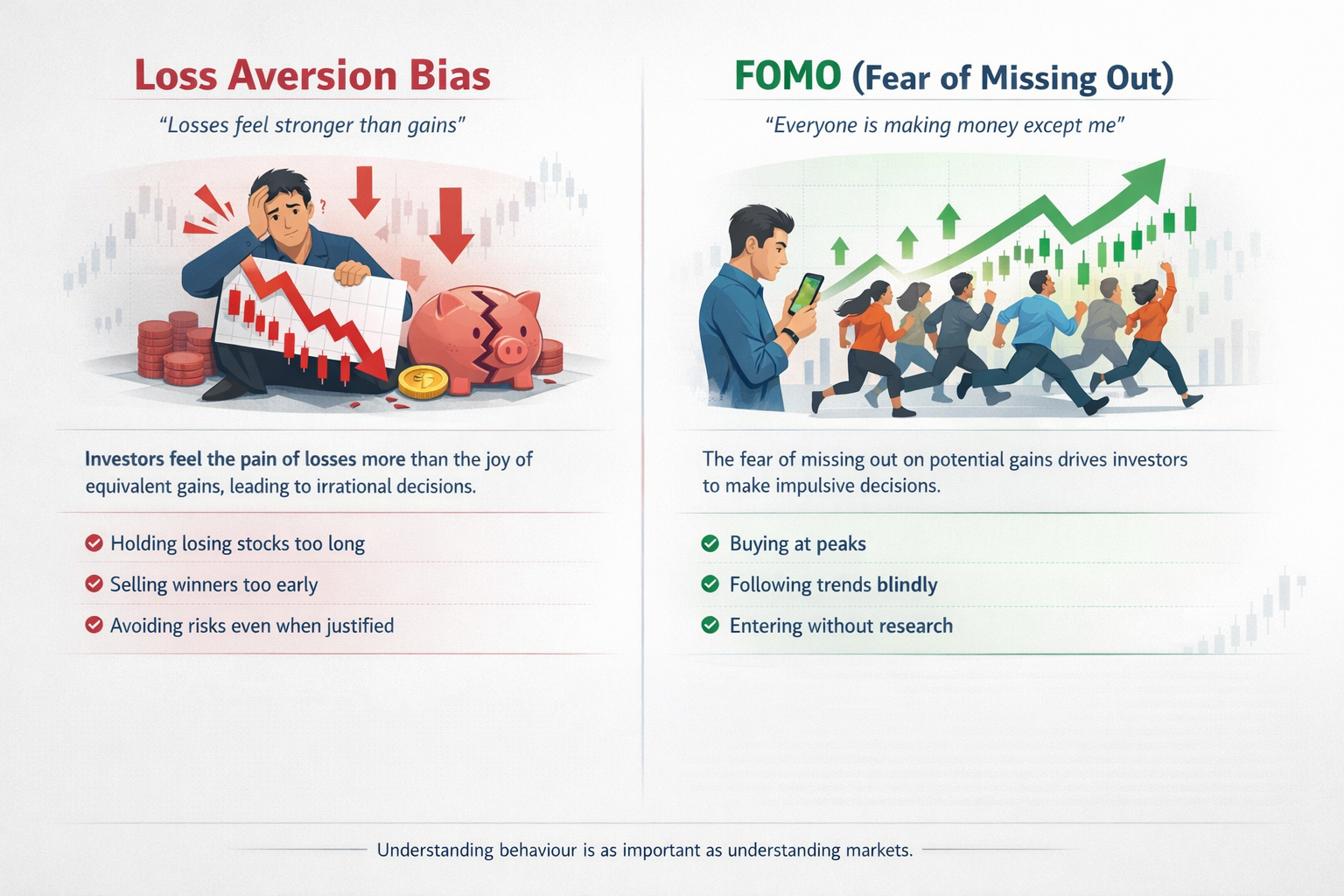
Psychologists call the force behind steps 1 and 3 by specific names — FOMO (fear of missing out) and loss aversion. Studies show that the pain of losing ₹1,000 feels roughly twice as intense as the pleasure of gaining ₹1,000. So when a portfolio turns red, our brain screams “get out!” even when the rational move is to hold or even buy more
Then there’s the news problem. Financial news is not designed to help you make good decisions. It’s designed to keep you glued to the screen. “Markets crash,” “experts predict,” “this stock could 10x” — all of it creates noise that makes you feel like you need to act right now. And acting impulsively in investing is almost always the wrong thing to do.
Retail investors also suffer from something called recency bias — the tendency to assume that whatever just happened will keep happening. If markets have been rising for six months, we assume they’ll keep rising. If they’ve fallen for two weeks, we assume the world is ending. Neither is usually true.
“The stock market is the only market where people run away when things go on sale.”
So what can you actually do about it? The honest answer is: the fix is boring. It’s not a hot tip or a secret strategy. It’s discipline.
Invest regularly — every month, whether the market is up or down (this is called SIP or rupee-cost averaging). Stop checking your portfolio daily. Understand that short-term volatility is not the same as long-term loss. And most importantly, stop taking investment advice from the people winning right now — because by the time you’re hearing about it, the winning is often already over.
The institutions aren’t smarter than you because they have better data. They’re ahead because they remove emotion from the equation. That’s the real edge — and it’s available to anyone willing to be patient and a little boring.
The market will always reward those who wait. The trick is not letting your feelings kick you out before the reward arrives.